What My ER Doctor Cousin Told Me at the Jersey Shore
I was down at the Jersey Shore last week. Sun, sand, and a long overdue conversation with my cousin.
She's an ER doctor. She supervises residents. She told me something I want to share with you.
Every year, she has a resident or two who struggles with the basics. Checking emails. Staying organized. The everyday skills adults need just to function.
Forgetting to respond to a supervising physician. Missing a deadline for a patient note. Not knowing how to prioritize when five things land on their plate at once.
This year, it's not one or two. It's a lot of them.
I have to be honest. None of this surprises me. It's exactly what I see every day in my work.
But I have a feeling it might surprise you.
Most people don't realize what's really happening with kids and young adults right now. We hear about grades. We hear about test scores. We don't hear enough about this.
Here's the part that really matters. These residents made it through college. Then medical school. Then a residency program.
By every measure we usually use to judge success, they succeeded. And that's exactly the problem.
As parents, we watch our kids get good grades. We watch them get into a good college. We breathe a sigh of relief and assume that means they're set. That the hard part is over.
But academic success and executive function skills are not the same thing. They don't develop on the same timeline. And doing well in one does not mean the other is coming along too.
Nobody would call these residents lazy or unmotivated. They are brilliant. Capable. Academically accomplished in every way.
And still, so many of them are struggling with the same executive function skills I talk about here every single week. The transition never happened. It just got covered up by good grades.
Sound familiar?
I see this exact pattern in my middle schoolers. I see it in my high schoolers.
Bright kids. Capable kids. Kids who are getting good grades and still struggling to keep track of an assignment, start a project, or manage their time.
The academics were never the problem. And getting into a good college doesn't mean the problem is solved.
Here's what I want every parent to know.
Task initiation and attention are foundational skills. Not advanced ones.
Organization, planning, and time management get all the attention. But those are the advanced skills. They sit on top of a foundation.
A student can build an impressive academic record without ever building that foundation. Which means the gap doesn't show up until later. Often when the stakes are higher and the support is harder to find.
This is exactly why I train my coaches in executive functions and the science of learning. We start at the foundation. Every time.

Before school starts, send your child's new teachers a brief letter introducing who your child is, beyond their diagnosis or their file. Not a list of deficits. A picture of a whole person. What helps them feel safe. What shuts them down. What they are hoping for this year in their own words. What has worked in the past and what has not.
A few things worth including: how your child responds to praise and correction, what kind of workspace helps them focus, whether morning or afternoon works better for demanding tasks, and how you prefer to communicate if something comes up.
Keep it warm, specific, and brief. Teachers receive a lot of information at the start of the year. A letter that feels human and clear is far more likely to be read and remembered than a clinical summary.
To make this easier, we have put together a free parent letter template you can download, fill in, and send before the first day of school. It covers everything a teacher needs to know to give your child the best possible start.
A Small Ask
I have openings right now for new students.
There are a lot of coaches out there. I know it can be hard for parents to know who to trust.
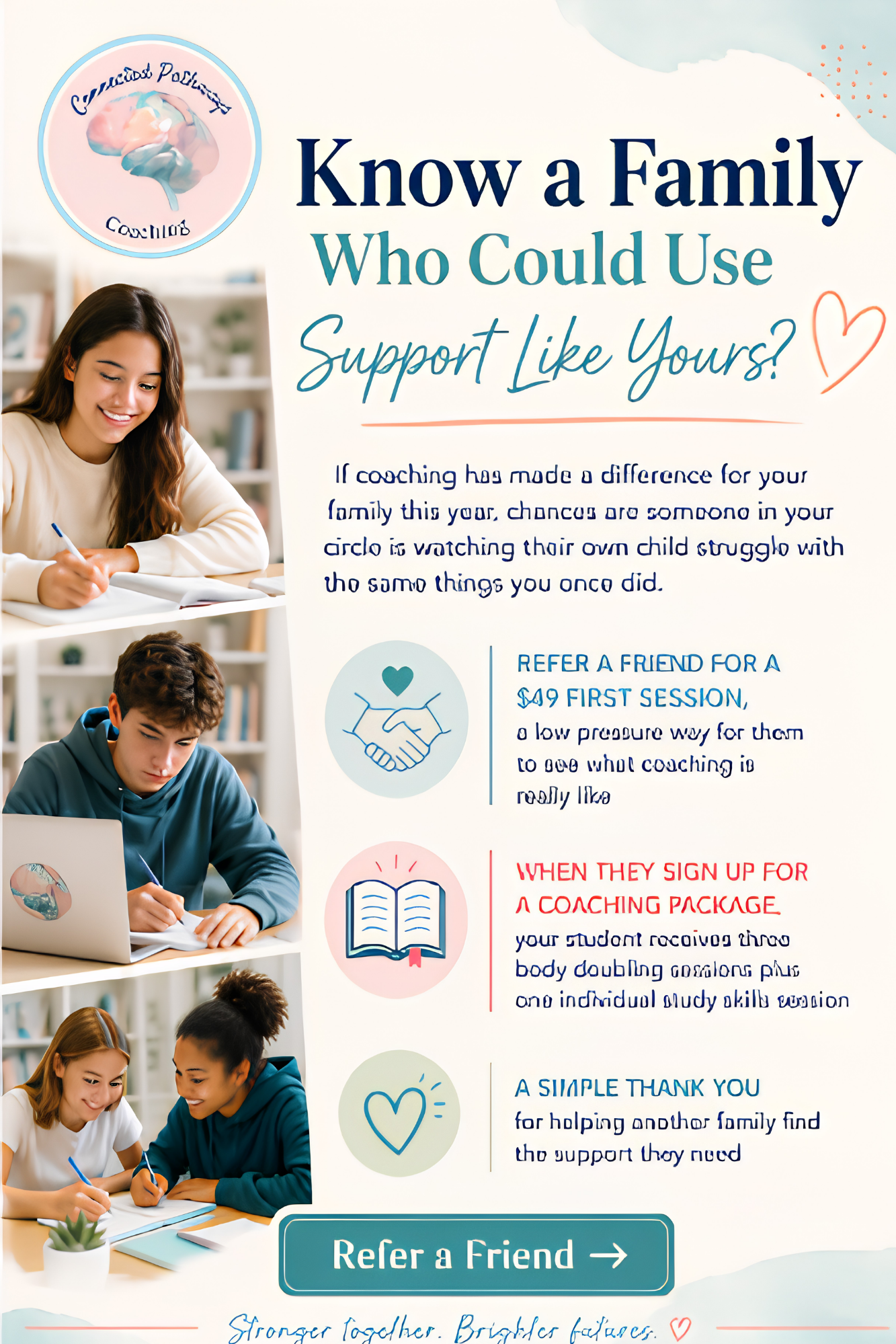
So I'm offering a $49 first session! A low pressure way to see what coaching with us actually looks like.
If you know a friend or family member whose child could use this kind of support, I would love an introduction.
And if your recommendation signs up for a coaching package, I'll include three body doubling sessions and one individual study skills session for your own student, as a thank you!
Crista is speaking at TEFOS, The Executive Function Online Summit!
Crista is joining a lineup of over 30 executive function and ADHD experts at TEFOS later this week!
Seth Perler has set this year up perfectly. Each professional speaks for about 15 minutes, so you get real, practical insight in short bites you can actually fit into your day.
Crista's session, Lying as a Clue, looks at what it actually means when a student isn't telling the truth, and why it's rarely about character.
The summit is completely free, running August 14 through 17, with workshops from professionals who understand exactly what you're navigating.